529 Plan or Roth IRA? A Smarter Education Funding Strategy
New Rules on Education Funding Every Family Should Understand
Back-to-school season has a way of sharpening our focus.
Maybe you’re buying school supplies for your children, helping a grandchild get ready for the fall semester, or simply looking at how quickly the years are passing and realizing college is not as far away as it once seemed. This time of year, often prompts an important financial question: Am I saving for education in the most effective way possible?
For many families, the answer starts with two familiar options: the 529 plan and the Roth IRA.
Both can play a role in education planning. Both offer meaningful tax advantages. And thanks to changes under SECURE 2.0, the conversation has become even more interesting, because unused 529 plan assets may now be rolled into a Roth IRA for the same beneficiary, subject to specific rules and limitations.
That change matters.
For years, one of the biggest concerns I heard from parents and grandparents was simple: What if we save too much in a 529 plan and the money does not get used for education? That concern caused some families to underfund college savings or avoid 529 plans altogether. Today, that decision deserves a fresh look.
Why Back-to-School Season Is the Right Time to Revisit Education Savings
Education planning is not something I believe should sit in a drawer untouched for years.
A family’s income changes. Tax laws change. Children’s goals change. Grandchildren may choose different paths than originally expected. And the closer college gets, the more important it becomes to make sure your savings vehicles still match your broader financial plan.
This is especially important for higher-income families and successful professionals who are often balancing multiple priorities at once:
- Saving for college or private school
- Maximizing retirement contributions
- Managing taxes efficiently
- Preparing for a work-optional future
- Deciding how much financial support to provide children or grandchildren
In my experience, the best education savings strategy is rarely about choosing one account in isolation. It is about understanding how that choice fits into your overall financial plan.
What Makes a 529 Plan So Valuable?
A 529 plan remains one of the strongest tools available for dedicated education savings.
If your goal is to set aside money specifically for education and give those dollars the opportunity to grow tax efficiently, a 529 plan is often the first place I look.
Key Benefits of a 529 Plan
-
Tax-free growth for qualified education expenses
When used for qualified education expenses, distributions from a 529 plan are 100% tax free. That can be a major advantage over taxable brokerage accounts or other savings vehicles.
Depending on your state, you may also qualify for a state income tax deduction or credit for contributions.
-
Broad education uses
Many people still think of 529 plans as “college only” accounts, but that is too narrow.
529 plan assets can generally be used for:
- College and university expenses
- Graduate school expenses
- Certain vocational and technical programs
- Up to allowable limits for private K-12 education
That broader use has made 529 plans more versatile than many families realize.
-
High contribution potential
Unlike Roth IRAs, 529 plans do not require the beneficiary or contributor to have earned income. They also come with much higher contribution capacity than annual IRA limits.
For grandparents, business owners, and high-income households who want to accelerate education gifting, that can be a significant advantage.
-
New rollover flexibility under SECURE 2.0
This is where the planning conversation has changed.
Under SECURE 2.0, unused 529 plan funds may be rolled to a Roth IRA for the same beneficiary, subject to several important rules. That means a 529 plan no longer has to feel like an all-or-nothing bet on education.
The rollover opportunity can help reduce the fear of overfunding, though it is not unlimited and should not be misunderstood as a blank check.
What Are the Limits on Rolling a 529 Plan into a Roth IRA?
This is the part families need to handle carefully.
Yes, the new rule is helpful. No, it does not mean every unused 529 dollar can instantly move into a Roth IRA.
Important 529-to-Roth IRA Rules to Understand
- The lifetime rollover limit is $35,000 per beneficiary
- Rollovers are subject to the annual Roth IRA contribution limit
- The beneficiary generally must have taxable compensation
- Other eligibility requirements apply
- Not every dollar in a 529 plan may qualify for immediate rollover treatment
In other words, this is a valuable planning feature, but not a reason to ignore contribution discipline.
I view this rule as a safety valve, not a license to overfund aggressively without a strategy.
Where a Roth IRA Fits into Education Planning
A Roth IRA is not designed primarily as a college savings account, but it can be a powerful planning tool because of its flexibility.
That flexibility is exactly why some families prefer it, especially if they are uncertain how much will ultimately be needed for education.
Key Benefits of a Roth IRA
-
FAFSA treatment can be favorable
One advantage often cited is that Roth IRAs are not counted as an asset on the FAFSA. By contrast, 529 plan balances are generally considered in the aid formula.
That does not automatically make the Roth IRA the better choice, but it is an important planning point for some families.
-
Greater flexibility if plans change
This is one of the biggest reasons people like Roth IRAs.
Money in a Roth IRA does not have to be used for education. It can remain earmarked for:
- Retirement
- Education expenses
- A first home purchase, subject to applicable rules
- Other future needs, depending on distribution rules
That flexibility can be valuable for families who want optionality rather than a dedicated-use account.
-
Potential for tax-free distributions
If you are over age 59 1/2 and have satisfied the five-year rule, qualified Roth IRA distributions can be tax and penalty free.
Even before that age, contributions can generally be accessed without tax or penalty. That feature gives Roth IRAs a flexibility edge that dedicated education accounts do not always offer.
The Trade-Off: Flexibility vs. Purpose
This is where I encourage families to slow down.
A Roth IRA may be more flexible, but flexibility can come at a cost. If you use retirement assets to pay for college, that is money no longer compounding for your later years. In some cases, families end up weakening a retirement plan in order to solve an education funding goal.
A 529 plan, on the other hand, creates guardrails. It keeps education savings separate and intentional.
So the better question is not simply, which account is better? The better question is: What job do I want this money to do?
If the money is clearly intended for education, a 529 plan often makes sense.
However, if flexibility is the top priority and retirement savings are already well on track, a Roth IRA may deserve consideration.
If you are in a high-income household, the answer may be a coordinated strategy that uses both.
A Real-World Case Study: Parents Who Wanted Flexibility Without Overcommitting
A couple I will call Mark and Jennifer came to us in their early 50s. They were high earners, had done a solid job building retirement assets, and had two children approaching college age. Like many successful families, they had the capacity to save, but they were wrestling with the “what if” questions.
What if one child received scholarships?
In reality, the younger child chose a less expensive path?
What if they saved too much in a 529 plan and got stuck with penalties later?
Their initial instinct was to avoid adding much to the 529 plans and keep everything flexible. On the surface, that felt prudent. But when we stepped back, the real issue was not a lack of savings capacity. It was a lack of clarity around which dollars were for college and which dollars were for retirement.
We worked through the trade-offs carefully.
First, we identified how much of their future retirement was already well supported. Then we estimated a reasonable education funding target rather than guessing high or low. We also reviewed the newer rules allowing certain unused 529 assets to be rolled into a Roth IRA for the beneficiary, subject to the limits.
That changed their comfort level.
Instead of underfunding education out of fear, they decided to keep building their 529 balances for known education goals while preserving other assets for flexibility. The result was a more intentional plan: college dollars were set aside where they belonged, retirement dollars remained protected, and the new rollover rules reduced their anxiety about overfunding.
The biggest win was not the account type alone. It was confidence that their plan had become more coordinated.
Common Mistakes I See Families Make
When I talk with families about college savings, a few patterns come up again and again.
Treating education planning separately from retirement planning
This is one of the most common issues. Families often focus on helping children without fully measuring the impact on their own long-term security.
I believe education funding should support family values, but not at the expense of an unstable retirement.
Overvaluing flexibility without defining purpose
Flexibility sounds appealing, but money without a defined job often gets pulled in too many directions.
A Roth IRA can be flexible. That does not automatically mean it should serve as your primary education savings vehicle.
Avoiding 529 plans because of outdated assumptions
Some families still think a 529 plan is too restrictive to be useful. That concern deserves a second look, especially now that education uses are broader and SECURE 2.0 has introduced more flexibility for unused funds.
Saving without a coordinated tax strategy
The right account is not just about investment growth. It is also about taxes, aid formulas, timing, and how withdrawals fit your broader plan.
That is why these decisions are better made strategically than emotionally.
529 Plan vs. Roth IRA: Which Is Better?
The honest answer is that it depends on your priorities.
Here is the way I think about it:
| If your priority is… | A 529 Plan may fit better | A Roth IRA may fit better |
| Dedicated education savings | Yes | Sometimes |
| Maximum flexibility | Limited | Yes |
| Tax-free qualified education distributions | Yes | Potentially, depending on rules |
| Higher contribution potential | Yes | No |
| No earned income requirement | Yes | No |
| Retirement backup use | No | Yes |
| SECURE 2.0 rollover opportunity | Yes | Receives rollover, subject to rules |
For many families, this is not an either-or decision. A thoughtful blend can often create the right balance of purpose, tax efficiency, and flexibility.
Questions I Encourage Families to Ask Before Choosing
Before deciding how to save, I think it helps to ask:
- How certain am I that these funds will be used for education?
- Am I already on track for retirement without relying on these dollars?
- Do I need flexibility more than I need dedicated tax advantages?
- Could overfunding create a problem, or does SECURE 2.0 reduce that concern enough?
- How does this fit with my tax picture and long-term estate goals?
These are planning questions, not just product questions.
And that distinction matters. The goal is not to find the “best account” in the abstract. The goal is to make a smart decision in the context of your own financial life.
My Take: Start With the Plan, Not the Product
When families are deciding between a 529 plan and a Roth IRA, I do not think the best starting point is a checklist of features.
The better starting point is your overall plan.
If retirement is not yet on solid footing, I want to be careful about using retirement vehicles as education funding tools. Perhaps your family has ample resources and a strong long-term plan, then flexibility may matter more. Also, if your children or grandchildren are young and education funding is a clear priority, a 529 plan may still be the cleanest and most effective choice.
And now, because of SECURE 2.0, the downside of leftover 529 funds may be less severe than many people assumed.
That makes this a good time to revisit old assumptions and make sure your current strategy still fits.
Download Our Education Savings Guide
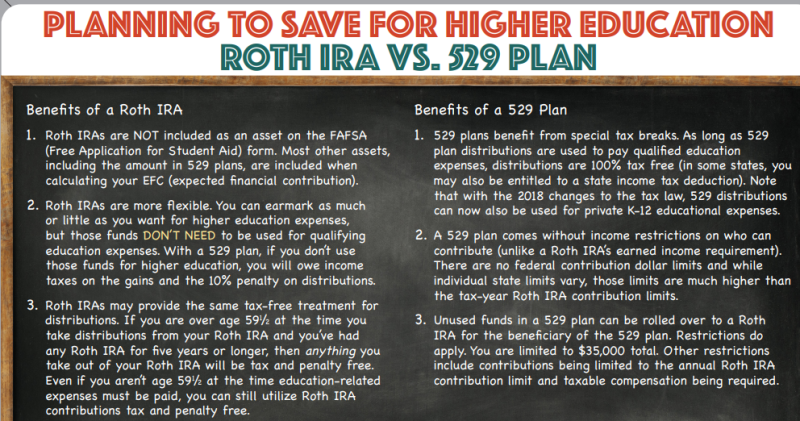
If you want to go deeper on this topic, download “Planning to Save for Higher Education: Roth IRA vs. 529 Plan“ for additional insight into the trade-offs, planning opportunities, and rules involved.
Financial success doesn’t happen by chance. It takes careful planning and expert advice.
Call RFG Wealth Advisory Today
Back-to-school season is about more than backpacks, tuition bills, and calendars. It is also a reminder that time moves quickly, and financial decisions made now can have a lasting effect on your family.
If you are saving for a child or grandchild’s education, this is a smart time to evaluate whether your current strategy still makes sense. The right answer may involve a 529 plan, a Roth IRA, or a combination of both. What matters most is that the strategy works in concert with your retirement, tax, and legacy goals.
Contact one of our RFG Wealth Advisory financial advisors at 940-464-4104, to discuss your education planning questions. You may also schedule a free virtual consultation on our website, here. RFGWealthAdvisory.com/virtualconsultation/
RFG Wealth Advisory in Argyle, Texas, is an independent, fee-only Registered Investment Advisor firm that always puts our clients’ interests first. We have a transparent, simple fee structure that’s easy to understand. Call us Today!
Investment advice is offered through RFG Wealth Advisory, a Registered Investment Advisor.
Planning to Save for Higher Education: Roth IRA vs. 529 Plan Checklist
Disclaimer
Financial Success Doesn’t Happen by Chance.
Contact lead advisor Chris Robinson with RFG Wealth Advisory in Argyle, Texas to discuss your questions.
RFG Wealth Advisory is an independent, fee-only Registered Investment Advisor firm in Argyle, Texas. At RFG Wealth, our fiduciary duty ensures your interests always come first, and we maintain a transparent fee structure for your peace of mind. Contact us today!
Investment advice is offered through RFG Wealth Advisory, a Registered Investment Advisor.
Schedule a Virtual Consultation
Chris Robinson is the managing partner and founder of RFG Wealth Advisory, which he founded in 1995. He is a current resident of Argyle and native of Denton, Texas.